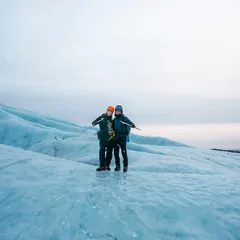
Natural or cut
Natural ice cave or cut tunnel: which one you are actually booking
Two completely different things are sold under the words “ice cave” in Iceland. One is a passage that meltwater carved and will destroy again by spring. The other is six hundred metres bored into an ice cap with machines and open every day of the year. Neither is a con. Booking one while expecting the other is the commonest disappointment in this niche.
Quick answer
A natural cave is made by water, is different every year, and can only be entered roughly November to March. A cut tunnel is made by machine, is the same every visit, and is open every day of the year. The natural caves are in Vatnajökull and cost from $149. The tunnel is in Langjökull and costs $176 from Húsafell, or $305 with the coach from Reykjavík.
The two, side by side
- Natural: how it forms
- Meltwater cuts itin summer, then drains in winter
- Cut: how it forms
- Machines bore itsix hundred metres into Langjökull
- Natural: season
- About Nov to Marunsafe outside that window
- Cut: season
- Every day of the yearincluding July
- Natural: the same twice?
- Almost nevera new passage every winter
- Cut: the same twice?
- Yesmaintained and lit
- Natural: floor
- Ice under black sanduneven, sometimes a crawl at the entrance
- Cut: floor
- Level and maintainedwith handrails in places
- Natural: from
- $149a walk on the glacier and a cave under it
- Cut: from
- $176from Húsafell in west Iceland
The natural cave
Water makes it, water destroys it
A drainage channel that drains. That is the whole thing.
Every summer, meltwater pours off the surface of a glacier, finds a crack and vanishes into it. Underneath the ice it carves a channel on its way out to the plain, the way a river carves a canyon, except it takes months rather than millennia.
In winter the melt stops. The channel drains, and what is left is a passage inside the glacier with walls of ice that may be centuries old. Guides walk the snouts each autumn looking for that year’s passages, assess which ones are safe, and start taking groups in when the ceilings have frozen hard enough to hold.
In spring the melt restarts, the ceiling thins, the passage fills, and sooner or later it either collapses or is enlarged past recognition. Meanwhile the glacier has moved a few metres downhill. Next winter the water takes a different line.
That cycle explains everything about how these tours are sold. Operators do not name a chamber, because they cannot. Photographs on a booking page are from previous seasons. Guides close a cave without warning when the ice starts talking. And the season is short, because the physics of a drainage channel says so.
The cut tunnel
Honest about being made
Reliable, level, lit, and open in July. It is not a consolation prize.
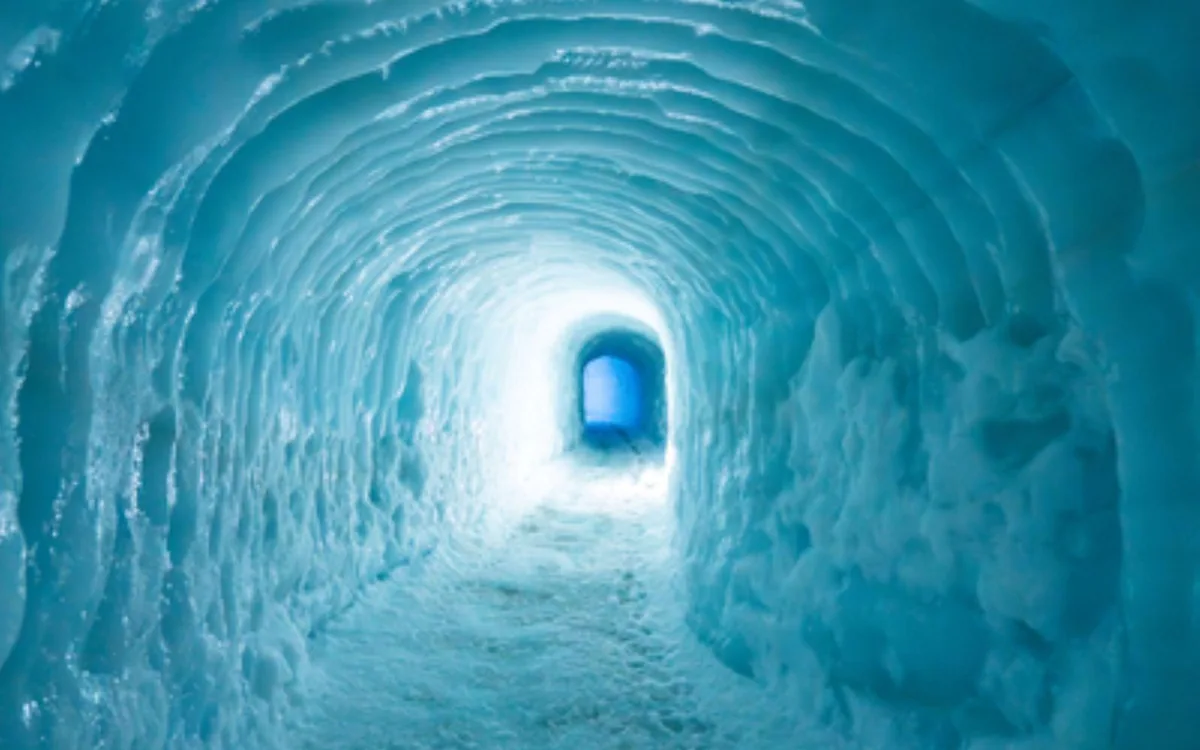
Into the Glacier is a tunnel bored into Langjökull, Iceland’s second largest ice cap, in the west of the country. It is roughly six hundred metres long and sits about thirty metres below the surface of the ice. Inside there are lit chambers, a section where you can see the annual layers of snowfall stacked in the wall like pages, and a small chapel.
You reach it from Húsafell on a specially built vehicle that drives up onto the ice cap — that drive, across the white top of a glacier with nothing on the horizon, is a genuine part of the experience and not merely transport.
It is not a natural cave and nobody involved claims otherwise. What it is, is reliable. It is open in July. It is open when the south-east is closed by weather. The floor is level, there is no moraine to cross, and it works for people who could not manage the walk into a natural cave. For a family with small children, or for a summer trip, it is not a consolation prize — it is the correct booking.
One more thing it has that the natural caves do not: you can see the layers. In a cut wall the annual snowfalls are visible as stripes, with the dark volcanic ash years standing out among them. It is the clearest illustration of how a glacier is actually built that you will find anywhere.
Every trip, current fare
Every tour, natural and cut
The column that matters here is the fourth: whether you are inside natural ice, inside a cut tunnel, or between the walls of a crevasse with the sky above you.
| Tour | Length | Price | Inside the ice? | Cost per hour | Rating |
|---|---|---|---|---|---|
| Skaftafell: Blue Ice Glacier Hike on VatnajökullThe blue ice of Vatnajökull on foot, most reviewed here | 4 h | $100 | No — on top | $25.00 | 4.7 · 1,501 |
| Skaftafell: Blue Ice Maze Glacier Hike on VatnajökullBetween crevasse walls rather than under a roof | 4 h | $133 | Crevasse, no roof | $33.25 | 4.4 · 275 |
| Iceland: Vatnajokull Glacier Hike and Ice Cave TourA walk on the glacier and a cave, cheapest inside | 4 h | $149 | Yes, natural | $37.25 | 4.6 · 21 |
| Jökulsárlón: Vatnajökull Glacier Ice Cave Tour by Super JeepStraight to the cave with the shortest walk | 3 h | $151 | Yes, natural | $50.33 | 3.4 · 6 |
| Skaftafell: Blue Ice Cave & Glacier Hike on VatnajökullA glacier walk and a cave under it, small group | 4 h | $152 | Yes, natural | $38.00 | 4.6 · 849 |
| Jökulsárlón: The Original Ice Cave Tour on VatnajökullThe longest-running cave tour from the lagoon | 3 h | $159 | Yes, natural | $53.00 | 4.6 · 1,131 |
| Jökulsárlón Ice Cave Tour - Inside Vatnajökull glacierThe shortest cave tour on this page | 2.5 h | $163 | Yes, natural | $65.20 | 4.7 · 65 |
| From Jökulsárlón: Crystal Blue Ice Cave Super Jeep TourThe crystal cave, reached by super jeep | 3 h | $164 | Yes, natural | $54.67 | 4.5 · 605 |
| Jökulsárlón: Breiðamerkurjökull Glacier Ice Cave TourThe glacier that calves into the lagoon | 3.5 h | $171 | Yes, natural | $48.86 | New |
| From Húsafell: Into the Glacier Ice Cave AdventureSix hundred metres cut into Langjökull, open all year | 4 h | $176 | Yes, cut | $44.00 | 4.7 · 857 |
| From Jokulsarlon: Crystal Blue Ice Cave Discovery TourA crystal cave tour with a low group cap | 3 h | $178 | Yes, natural | $59.33 | 5.0 · 1 |
| From Jökulsárlón: Vatnajökull Glacier Blue Ice Cave TourA small-group run to whichever cave is holding | 3 h | $184 | Yes, natural | $61.33 | 4.6 · 962 |
| From Jökulsárlón: Ice Cave and Glacier Exploration TourFive and a half hours, and more than one cave | 5.5 h | $259 | Yes, often two | $47.09 | 4.7 · 225 |
| From Reykjavik: Into the Glacier Ice Cave TourThe Langjökull tunnel with the coach from Reykjavík | 11 h | $305 | Yes, cut | $27.73 | 4.6 · 202 |
| Reykjavík: Langjökull Glacier Snowmobile Tour with Ice CaveA snowmobile across the ice cap, then the cave | 10 h | $340 | Yes, cut | $34.00 | 4.6 · 154 |
| From Reykjavik: 3-Day South Coast Winter Tour with Ice CaveThree days, with beds, meals and the aurora | 3 days | $906 | Yes, natural | $37.75 | 4.8 · 208 |
Which to book
Six situations, and the honest answer for each
The choice is usually made for you by one of these.
- Your dates are between April and October
The tunnel, without hesitation. The natural caves are shut and no operator can open them. The Katla cave in the south is the other year-round option.
- You want the photograph
A natural cave in Vatnajökull, in winter, from the lagoon. Nothing else looks like that, including the tunnel, which is lit rather than glowing.
- You are travelling with small children or anyone unsteady
The tunnel. Level floors, handrails, no crampons to learn and no loose moraine to cross in the wind.
- You are based in Reykjavík without a car
The tunnel, on the eleven-hour coach day. Reaching a natural cave from the capital and back in one winter day is not a realistic plan.
- You want to understand how a glacier works
The tunnel, oddly. The cut wall shows the annual layers stacked up with the ash years in between, which a natural passage never displays so clearly.
- You want both
They are in different parts of the country: Langjökull is in the west, the natural caves in the south-east. A week-long winter trip fits both comfortably; a long weekend does not.
There is a third option that needs neither a frozen ceiling nor a machine: walking between the walls of a crevasse, with blue ice on both sides and sky above.
Skaftafell in full→Common questions
Natural caves and cut tunnels, answered
Is the Langjökull ice tunnel a real ice cave?
It is a real tunnel inside a real glacier, cut by machine rather than by water. It is not a natural cave, and the operators describe it accurately. If what you want is to be inside a glacier, it delivers that every day of the year.
Which is better, the natural cave or the tunnel?
For the photograph and the blue, the natural cave. For certainty, accessibility and a summer date, the tunnel. They are different products rather than competing ones.
Can you visit a natural ice cave in summer in Iceland?
Not in Vatnajökull. Meltwater makes the ceilings unsafe from roughly April. The Katla cave above Vík is a natural cave that operates all year because its ice is thicker and more stable.
Is the ice tunnel worth the money?
For a summer visit, or a family, or anyone without a car in Reykjavík, yes. It is also the clearest place in Iceland to see how a glacier is built, because the cut wall shows the annual layers.
How long is the Langjökull ice tunnel?
About six hundred metres, roughly thirty metres below the surface of the ice cap, with lit chambers and a small chapel along the way.
Do I need crampons in the tunnel?
No. The floor is level and maintained. A helmet is supplied. This is one of the main practical differences from a natural cave.
Go deeper
More on walking into an Icelandic glacier
What an Iceland ice cave tour costs
Sixteen tours priced per person and per hour, from $100 to $906.
Blue iceThe blue ice cave in Iceland
Why the ice is blue, where the caves are, and what a tour actually shows you.
VerdictThe best Iceland ice cave tour
Sixteen tours ranked for one decision, with a straight answer at the end.
Crystal caveThe crystal ice cave
The cave behind most of the photographs, and why it is never the same one twice.
SkaftafellIce caves and blue ice at Skaftafell
The other meeting point, an hour closer to Reykjavik than the lagoon.
VatnajokullIce cave tours on Vatnajokull
Europe's largest ice cap, its outlet glaciers, and which caves sit in which.