Blue Ice Cave Iceland
See tours

When to go

The best time for an ice cave tour in Iceland, month by month

This is the single decision that matters most on this site, and it is not really about weather. The natural caves are drainage channels that only exist while the glacier is frozen hard, which is roughly five months of the year. Here is what each of those months is actually like, and what is open in the other seven.

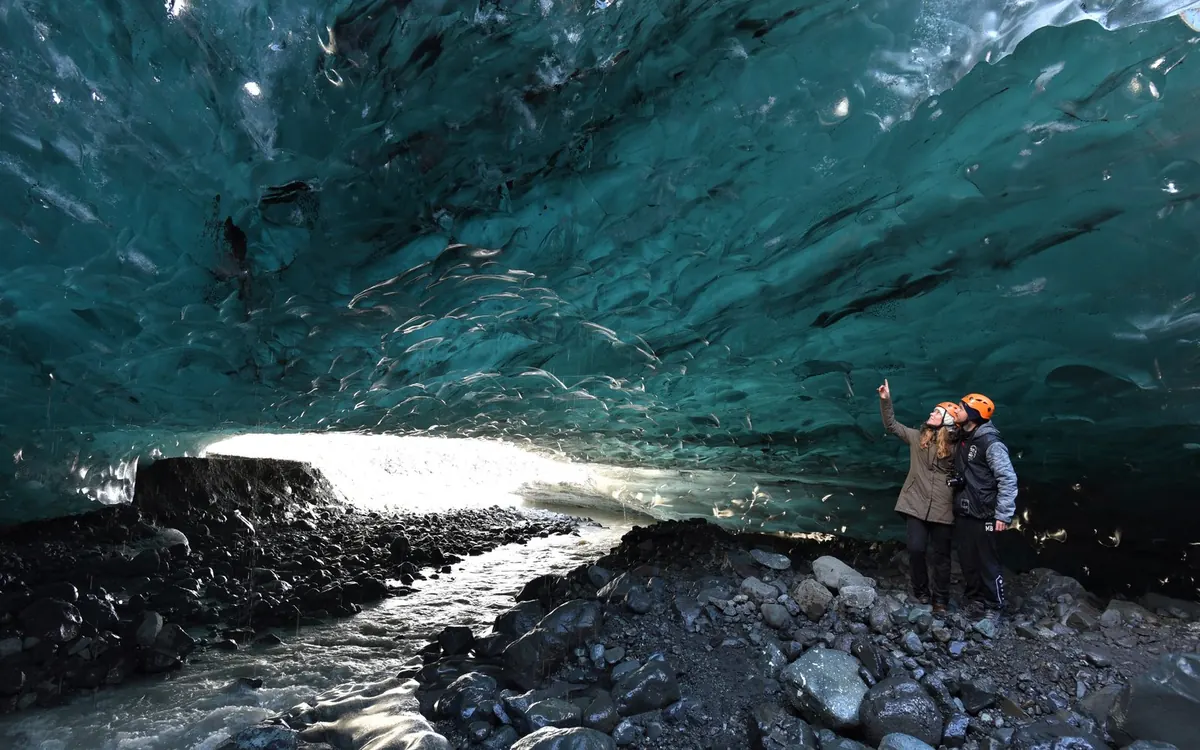
Meltwater running past the entrance of an ice cave in Iceland

Quick answer

January and February are the best months for a natural ice cave in Iceland. The glacier is fully frozen, the caves are at their most stable, and the blue is at its strongest. November and December open the season and share it with the longest aurora nights; March closes it with the most daylight and the lowest prices. From April to October the natural caves are shut, and the cut tunnel at Langjökull and the Katla cave are the only things open.

The season, at a glance

Natural caves open
About Novemberonce the melt has stopped and ceilings have frozen
Natural caves close
About Marchwhen meltwater starts working on them again
Best months
January and Februarycoldest, most stable, strongest blue
Longest nights
Decemberabout five usable daylight hours
Most daylight in season
Marchand the lowest prices of the winter
Open all year
The Langjökull tunneland the Katla cave above Vík
Busiest weeks
Christmas to mid-Februarysmall-group tours sell out first
Aurora overlap
All five monthsthe seasons are effectively identical
Blue ice walks
Most of the yeara surface walk needs no frozen ceiling
Cancellation
Free on all sixteenwhich makes booking early costless

Month by month

The five months the caves are open

Three calendars run at once inside the season — ice, daylight and crowds — and they do not peak in the same weeks.

Jan – Feb

The deep season

The coldest weeks of the Icelandic year, which is exactly what you want. The glacier is fully frozen, ceilings are at their most stable, guides have had two months to find and assess that season’s passages, and the blue is at its strongest. Daylight is short but what there is stays low and golden all day. Every tour on this site runs. It is also the busiest window, and the small-group tours go first.

Nov – Dec

Opening

Guides start entering caves as soon as the melt has stopped and the ceilings have frozen hard, which is usually some time in November. Which caves open and when changes every year, so the very start of the season carries a little more uncertainty. In exchange you get the longest nights of the year for the aurora and roads that are usually still easy.

Mar

Closing

The best combination of ice and daylight in the whole season: the caves are still open, and there is enough light to drive the south coast comfortably. Some caves close by mid-month as meltwater begins working on the roof again. Prices are at their lowest of the winter and the crowds have thinned.

Apr – Oct

Out of season

The natural caves are shut and nothing reopens them. Two things still run: the tunnel cut into Langjökull, which operates every day of the year, and the Katla cave above Vík, which sits in thicker and more stable ice. Blue ice walks on the surface of the glaciers also run through most of this period.

Why the season is what it is

The physics, in one paragraph, because it settles every other question

A drainage channel is only walkable while it is drained and frozen. That is the season.

In summer, meltwater runs off the surface of the glacier, finds a crevasse and disappears into it, carving a channel through the ice on its way out to the plain. That channel is full of running water and completely inaccessible. When the cold arrives the melt stops, the channel drains, and for a few months there is a dry passage inside the glacier.

Guides can only take people into it while the ceiling is frozen solid. Once the melt restarts in spring, the roof thins from above, water starts moving again, and the passage becomes something that collapses rather than something you walk through. There is no engineering fix and no amount of money changes it.

That is why every honest listing gives a season rather than a date range you can book year-round, and why the specific opening and closing weeks move from year to year. A cold October can open the season early; a mild February can close a particular cave while others stay open.
Every trip, current fare

Every tour, with what runs when

Thirteen of the sixteen tours here are seasonal. The three that are not are the Langjökull tunnel and the two Reykjavík departures that feed it.

TourLengthPriceInside the ice?Cost per hourRating
Skaftafell: Blue Ice Glacier Hike on VatnajökullThe blue ice of Vatnajökull on foot, most reviewed here4 h$100No — on top$25.004.7 · 1,501
Skaftafell: Blue Ice Maze Glacier Hike on VatnajökullBetween crevasse walls rather than under a roof4 h$133Crevasse, no roof$33.254.4 · 275
Iceland: Vatnajokull Glacier Hike and Ice Cave TourA walk on the glacier and a cave, cheapest inside4 h$149Yes, natural$37.254.6 · 21
Jökulsárlón: Vatnajökull Glacier Ice Cave Tour by Super JeepStraight to the cave with the shortest walk3 h$151Yes, natural$50.333.4 · 6
Skaftafell: Blue Ice Cave & Glacier Hike on VatnajökullA glacier walk and a cave under it, small group4 h$152Yes, natural$38.004.6 · 849
Jökulsárlón: The Original Ice Cave Tour on VatnajökullThe longest-running cave tour from the lagoon3 h$159Yes, natural$53.004.6 · 1,131
Jökulsárlón Ice Cave Tour - Inside Vatnajökull glacierThe shortest cave tour on this page2.5 h$163Yes, natural$65.204.7 · 65
From Jökulsárlón: Crystal Blue Ice Cave Super Jeep TourThe crystal cave, reached by super jeep3 h$164Yes, natural$54.674.5 · 605
Jökulsárlón: Breiðamerkurjökull Glacier Ice Cave TourThe glacier that calves into the lagoon3.5 h$171Yes, natural$48.86New
From Húsafell: Into the Glacier Ice Cave AdventureSix hundred metres cut into Langjökull, open all year4 h$176Yes, cut$44.004.7 · 857
From Jokulsarlon: Crystal Blue Ice Cave Discovery TourA crystal cave tour with a low group cap3 h$178Yes, natural$59.335.0 · 1
From Jökulsárlón: Vatnajökull Glacier Blue Ice Cave TourA small-group run to whichever cave is holding3 h$184Yes, natural$61.334.6 · 962
From Jökulsárlón: Ice Cave and Glacier Exploration TourFive and a half hours, and more than one cave5.5 h$259Yes, often two$47.094.7 · 225
From Reykjavik: Into the Glacier Ice Cave TourThe Langjökull tunnel with the coach from Reykjavík11 h$305Yes, cut$27.734.6 · 202
Reykjavík: Langjökull Glacier Snowmobile Tour with Ice CaveA snowmobile across the ice cap, then the cave10 h$340Yes, cut$34.004.6 · 154
From Reykjavik: 3-Day South Coast Winter Tour with Ice CaveThree days, with beds, meals and the aurora3 days$906Yes, natural$37.754.8 · 208
Natural or cut by machine

Choosing your month

Six situations and the month that fits

The right answer depends on what else you want out of the trip.

  • You want the strongest blue

    January or February. The coldest weeks produce the most stable caves in the oldest ice, and guides have had time to find the best of that season’s passages.

  • You want the aurora as much as the cave

    November or December for the longest nights, or February as the compromise: still long nights, more daylight for driving, and the caves fully open.

  • You are driving the south coast yourself

    March. There is enough daylight to make the drive comfortable, the roads are easier, and the caves are still open for most of the month.

  • You want the lowest price

    March, at the end of the season, or November at the very start. Both are shoulder weeks with the same ice and fewer people in it.

  • You are here in summer

    The cut tunnel at Langjökull, or the Katla cave above Vík. Both run every day of the year, and a blue ice walk on the surface of a glacier is also available.

  • You have one fixed week and cannot move it

    Book whatever is open in that week and book it early, because free cancellation means an early booking costs you nothing and a late one may find the small groups full.

Common questions

The best time for an Iceland ice cave, answered

When can you visit the ice caves in Iceland?

Natural caves run roughly from November to March. Guides enter them once the glacier has frozen hard enough for the ceilings to hold and stop when meltwater starts working on them again in spring.

What is the best month for an ice cave tour?

January or February. The glacier is fully frozen, the caves are at their most stable and the blue is at its strongest. March is the best compromise if you also want daylight for driving.

Can you see an ice cave in Iceland in summer?

Not a natural one in Vatnajökull. The tunnel cut into Langjökull runs every day of the year, and the Katla cave above Vík is a natural cave that also operates all year because its ice is thicker and more stable.

Do the exact dates change each year?

Yes. A cold autumn opens the season early; a mild spring closes it early. Individual caves also open and close independently as conditions change.

How much daylight is there in December?

About five usable hours in the south-east. That is why the tours cluster around midday and why booking a late departure in midwinter is not the bargain it appears to be.

When should I book?

For December to February, a week or more ahead, especially for the small-group tours. Every tour on this site cancels free, so booking early costs nothing.

Go deeper

More on walking into an Icelandic glacier

Skaftafell: Blue Ice Glacier Hike on Vatnajökull

4.7 · 1,501 reviews · Free cancellation 24 h

$100most reviewed Check dates