Blue ice
The blue ice cave in Iceland: where it is and what you actually see
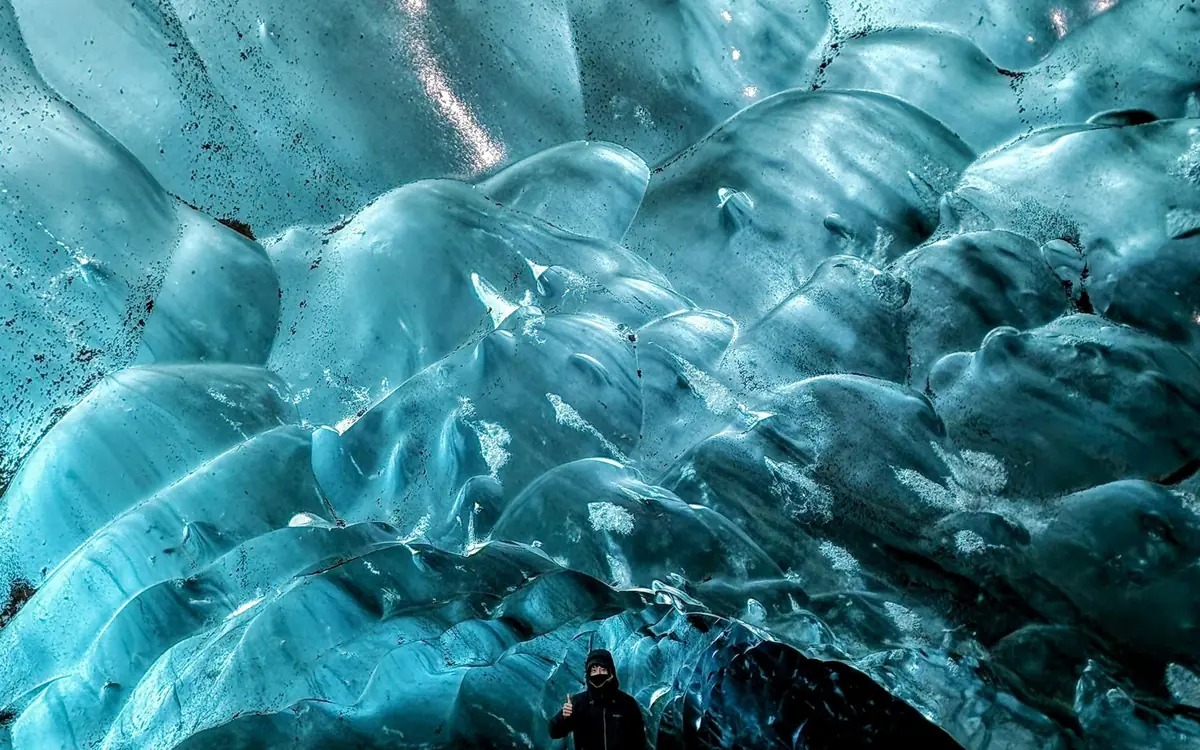
The photograph that made you look this up was taken inside a glacier, in a passage cut by meltwater and abandoned when the water froze. This page is where those caves are, why the ice is that colour, which tours reach them, and the two things about them that the photographs never show.
Quick answer
Iceland’s blue ice caves are inside Vatnajökull, Europe’s largest ice cap, and almost all of them are entered from the Jökulsárlón glacier lagoon or from Skaftafell. They can normally be visited only between about November and March. Tours from the lagoon run three hours, cost from $159, and put you under the ice for twenty to forty minutes of that. The colour is real: the weight of centuries of snow has squeezed the air out of the ice, and what is left scatters back only blue.
The blue ice cave, at a glance
- Which glacier
- Vatnajökulland its outlet glaciers, chiefly Breiðamerkurjökull
- Where you meet
- Jökulsárlón or Skaftafellboth on the south-east coast
- From Reykjavík
- About 380 kmfour and a half to five hours in good conditions
- Season
- About Nov to Maroutside it, meltwater makes the ceilings unsafe
- Typical tour
- 3 hoursof which twenty to forty minutes are under the ice
- From
- $159on the longest-running tour from the lagoon
- Getting to the cave
- Super jeep, then 15–25 min on footover loose moraine
- Supplied
- Crampons, helmet, harnesson every tour here
- Not supplied
- Waterproof bootsand guides do turn people away without them
- Same cave each year?
- Nomeltwater cuts new passages every spring
Why the ice is blue
Air, and the absence of it
Pressure squeezes the air out. Air-free ice absorbs everything except blue.
Snow is white because it is mostly air. Each flake is a little structure with gaps in it, and light bouncing around inside those gaps comes back out in every wavelength at once, which the eye reads as white.
Now bury that snow. More falls on top of it, and more on top of that, year after year. The layers below are compressed, the gaps close, and the air is gradually squeezed out. After enough decades what is left is glacial ice: dense, almost air-free, and behaving quite differently towards light. It absorbs the long wavelengths — red, orange, yellow — and scatters back the short ones. What comes out is blue.
This is why the guides take groups to particular caves and not others. The strongest colour is in the oldest, deepest, densest ice, and a cave cut into that ice glows in a way that a cave near the surface simply does not. It is also why the colour changes as you walk in: the further from daylight, the more the ice has to work on the light, and the deeper the blue goes.
One honest note about photographs. A phone on automatic will usually make an ice cave bluer than it looked, and a photographer with a light aimed at one wall can make it look bluer still. The colour is real. The saturation in the image that brought you here probably is not.
Where the caves actually are
Inside the glacier, not under a mountain
Vatnajokull and its outlet glaciers, on the south-east coast. Not near the capital.
A blue ice cave is not a cave in rock that happens to contain ice. It is a hole inside the glacier itself. In summer, meltwater runs over the surface, finds a crack, and disappears into it; underneath, it carves a channel through the ice on its way to the sea. In winter the melt stops, the channel drains, and what is left is a passage with walls of blue ice and a floor of the black sand the water was carrying.
Nearly all of Iceland’s famous caves sit in Vatnajökull, the largest ice cap in Europe, and specifically in its outlet glaciers on the southern side. Breiðamerkurjökull — the glacier that calves into the Jökulsárlón lagoon — produces most of them. Falljökull and Svínafellsjökull, reached from Skaftafell, produce others.
That geography has one practical consequence that catches people out constantly: the caves are on the south-east coast, not near Reykjavík. The lagoon is 380 kilometres from the capital. Skaftafell is an hour closer. Neither is a comfortable day trip from the city in winter, which is why the eleven-hour coach tours and the multi-day trips on this site exist at all.
There is one exception worth knowing about. The Katla cave, in Mýrdalsjökull above Vík, is a different kind of cave in a different kind of ice, much closer to Reykjavík, and it can be visited all year. The ice there is darker and more heavily ash-banded than the crystal caves, and people who booked it expecting the photograph on this page are sometimes surprised.
The caves are gone by April. If your dates are in summer, one thing on this site is still open, and it was cut by machine.
Natural cave or cut tunnel→The two things photographs never show
Black sand, and how long you are actually in there
Expect black bands and a sand floor. Expect twenty to forty minutes under the ice.
The black. Iceland is volcanic, and ash from past eruptions lands on the glaciers and is buried by the next winter’s snow. A cave cut down through those layers has black bands running through the blue, and a floor of black sand washed down by the same meltwater that made the passage. Most people find it more interesting than the pure blue they expected, but it is a surprise if nobody has mentioned it. It is also what stops the floor from being a skating rink.
The time. A three-hour ice cave tour is roughly forty minutes of driving each way, fifteen to twenty-five minutes of walking each way, and twenty to forty minutes under the ice. That is the shape of it, on every operator. People who book knowing this are almost never disappointed; people who imagined a half-day underground write the reviews that say the tour was too short. If you want more time inside, the five-and-a-half-hour tour at $259 is the one that gives it to you, and when conditions allow it visits more than one cave.
Choosing between them
Which blue ice cave tour to book
Six tours on this site go into natural caves from the lagoon. Here is what separates them.
- The one with the longest record
The tour at $159 has been running to these caves longer than anything else here and carries 1,131 ratings. If you want the safest choice, this is it.
- The one with the most reviews in the niche
The Skaftafell blue ice tour at $100 has 1,501 ratings, the most on this site — but read the title carefully: it walks on top of the glacier rather than inside a cave.
- The one that goes in deepest
The five-and-a-half-hour tour at $259 spends longer under the ice than anything else on this site, and visits more than one cave when the conditions allow.
- The small-group ones
Four tours here cap the group. At the entrance to a cave that is the difference between walking through and queuing, and it is worth more than most people expect.
- The one with the shortest walk
If loose moraine is the problem, the super jeep tour at $151 has the shortest approach on foot of any tour here.
- The one that does both halves
The four-hour tour at $149 walks across the glacier and then goes into a cave underneath it, which is the cheapest way on this site to do both.
Common questions
Blue ice caves in Iceland, answered
Where is the blue ice cave in Iceland?
Inside Vatnajökull, Europe’s largest ice cap, on the south-east coast. Most tours meet at the Jökulsárlón glacier lagoon car park, about 380 kilometres from Reykjavík, or at the Skaftafell visitor centre an hour closer.
Why is the ice blue?
Because the air has been squeezed out of it. Dense, air-free glacier ice absorbs the red and yellow wavelengths and scatters back only the blue. Older and deeper ice means stronger colour.
When can you see the blue ice cave?
Roughly November to March. The caves are cut by meltwater in summer and can only be entered safely once that water has stopped and the ceilings have frozen hard.
How long are you inside the cave?
Twenty to forty minutes on a standard three-hour tour. The rest is the jeep and the walk in. The five-and-a-half-hour tour gives you considerably more.
Is the blue ice cave the same as the crystal cave?
Usually, yes — crystal cave is a name operators use for whichever blue cave is open in the best ice that season. It is a description rather than a fixed location, which is why it moves from year to year.
Can you visit a blue ice cave without a guide?
No. The caves are inside a moving glacier, reached across an outwash plain closed to hire cars, and the ceilings are assessed daily. Every tour on this site is guided and supplies a helmet.
Go deeper
More on walking into an Icelandic glacier
What an Iceland ice cave tour costs
Sixteen tours priced per person and per hour, from $100 to $906.
VerdictThe best Iceland ice cave tour
Sixteen tours ranked for one decision, with a straight answer at the end.
Crystal caveThe crystal ice cave
The cave behind most of the photographs, and why it is never the same one twice.
SkaftafellIce caves and blue ice at Skaftafell
The other meeting point, an hour closer to Reykjavik than the lagoon.
VatnajokullIce cave tours on Vatnajokull
Europe's largest ice cap, its outlet glaciers, and which caves sit in which.
KatlaThe Katla ice cave
A different glacier, a different kind of cave, and a season that runs all year.